
Corporate AV Rental in Calgary: What Do You Actually Need?
Most people organizing a corporate event know when they need AV. There’s going to be a presentation, a few speakers, perhaps a panel discussion or some awards to hand out. People need to hear what’s being said, see what’s on the screen, and generally understand what’s happening at the front of the room.
Figuring out exactly how to make that happen is another matter.
A microphone seems straightforward enough, until you realize there are different types, different ways of using them, and different considerations depending on who’s speaking. The same goes for speakers, projectors, screens, and all the other equipment that can quickly turn a relatively simple request into a surprisingly technical conversation.
If you’re organizing a corporate event in Calgary, you shouldn’t need an AV production background to make good decisions about your equipment.
You just need to understand what your event requires, where professional support makes a difference, and where you can keep things simple.
Here’s how to approach corporate AV rental in Calgary without overcomplicating things or paying for equipment you don’t need.
Do you need speakers? How many microphones? A projector? A screen? Is there already a sound system at the venue? And perhaps the most common question of all: Do we actually need a technician?
If you’re organizing a corporate event in Calgary, figuring out your audio-visual requirements can feel unnecessarily complicated, particularly if event production isn’t something you deal with regularly.
The good news is that most events don’t require an elaborate production setup. The trick is understanding what your event needs to accomplish, identifying the equipment required to make that happen, and knowing when having professional technical support makes sense.
Because there’s a fairly significant difference between having a microphone in the room and making sure everyone can actually hear what’s being said.
Here’s how to approach corporate AV rental in Calgary without overcomplicating things or paying for equipment you don’t need.
Start With the Event, Not the Equipment
It’s tempting to approach AV planning as a shopping list.
Two speakers. A microphone. A projector. Maybe another microphone, just in case.
But equipment should be selected based on the event, not the other way around.
A small boardroom presentation has very different requirements from a corporate conference, an awards ceremony, or a gala with several presenters, video playback, and a full evening program.
Before requesting an AV quote, think about what will actually be happening.
Are people primarily sitting and listening to one presenter? Will there be multiple speakers moving around a stage? Are you showing PowerPoint presentations, videos, or branded content? Will there be audience questions? Is the event taking place in one room or several?
These details determine what equipment is appropriate.
A straightforward presentation might only need a compact sound system and one wireless microphone. A panel discussion could require several microphones, a larger audio mixer, and someone managing the levels throughout the conversation.
A conference with multiple presentations and visual content introduces another layer of considerations.
The objective isn’t to build the biggest AV setup possible. It’s to build one that supports the event without introducing unnecessary complexity.

1. Sound: The Most Important Place to Start
If there’s one part of your AV setup worth getting right, it’s sound.
People are generally quite forgiving of a presentation that doesn’t have spectacular lighting. They’re considerably less forgiving when they can’t understand the person speaking.
A professional sound system needs to do more than produce noise. It needs to deliver clear, consistent audio throughout the room.
That means considering the size of the venue, the number of guests, the room layout, ceiling height, and where the speakers will be positioned.
A small meeting room might be perfectly comfortable with a compact PA system. A larger conference room or ballroom will likely require a more substantial setup to ensure people seated at the back can hear just as clearly as those near the front.
It’s also worth remembering that more speakers don’t automatically mean better sound. Placement, coverage, and proper audio levels are just as important as the equipment itself.
When arranging corporate AV rental in Calgary, ask your provider how the proposed sound system will accommodate your actual room and guest count.
A system that’s appropriate for 50 people in a small meeting space isn’t necessarily appropriate for 150 people in a hotel ballroom.
The goal is simple: Everyone should be able to hear comfortably, without the people sitting near the speakers feeling like they’re attending a rock concert.
2. Microphones: How Many Do You Actually Need?
Microphones are one of those things that seem straightforward until you start thinking about how many people will be using them.
For a single presenter, one wireless microphone is usually a reasonable starting point.
But what if you have a keynote speaker, an MC, and two executives presenting awards? What if there’s a panel discussion with four participants? What happens when someone in the audience asks a question?
Suddenly, one microphone isn’t going to accomplish very much.
Different microphones also serve different purposes.
Handheld wireless microphones are versatile and work well for speakers, hosts, announcements, and audience participation. They’re easy to pass between people and don’t require the presenter to wear anything.
Lapel microphones attach to clothing and allow presenters to speak hands-free. They’re particularly useful for keynote presentations, demonstrations, or speakers who move around while talking.
Headset microphones provide hands-free operation while keeping the microphone consistently positioned near the speaker’s mouth. They’re useful for presenters who move frequently or need to use both hands.
The right choice depends on the format of your event and the preferences of your presenters.
One other consideration: Having enough microphones is only part of the equation. Someone needs to manage microphone levels, coordinate handoffs, monitor batteries, and make sure the next speaker is ready when their turn arrives.
For a simple meeting, that may be relatively straightforward. For a panel discussion or multi-speaker program, having an experienced technician managing the audio can make a considerable difference.
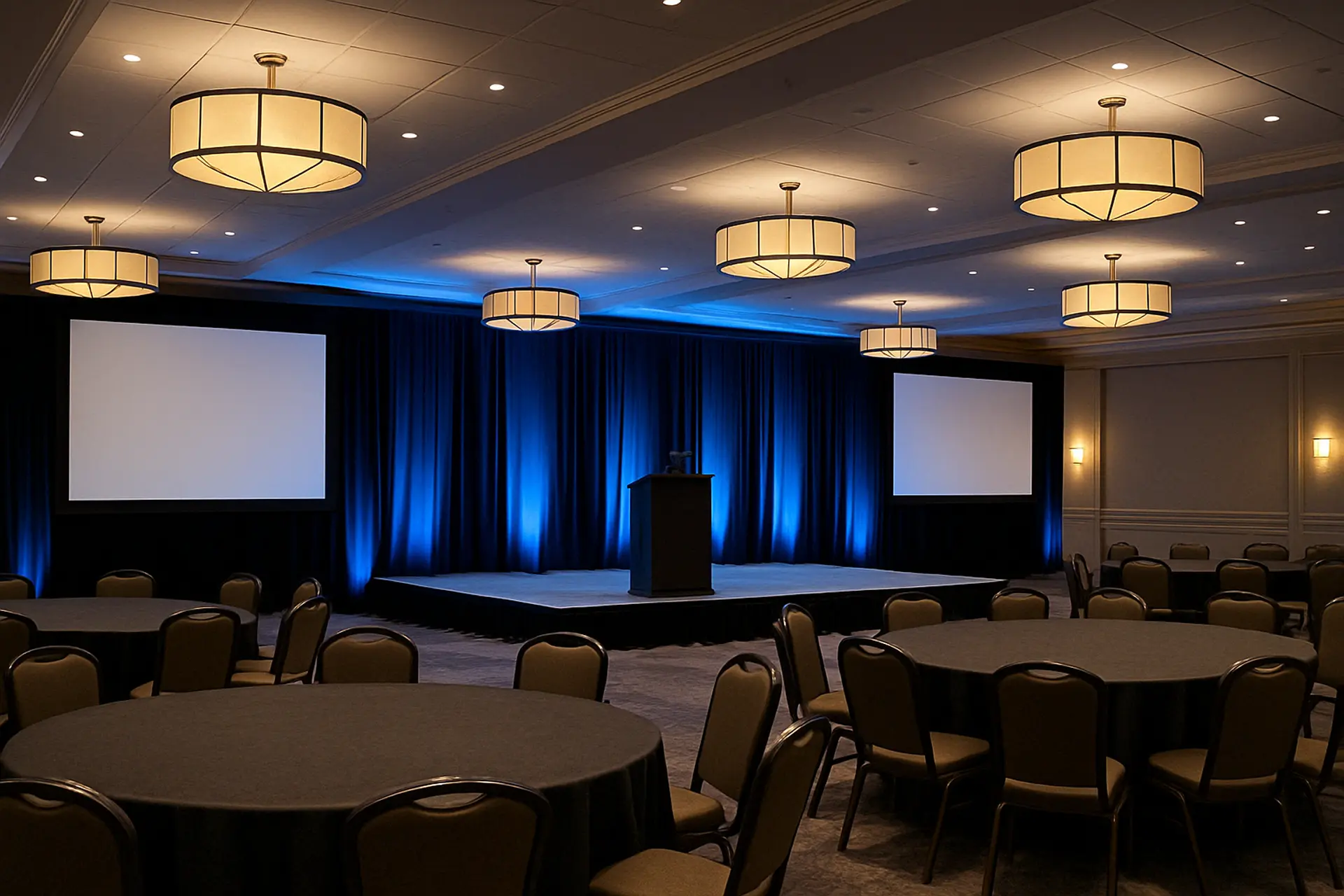
3. Projectors and Screens: Does Your Audience Actually Need Them?
Visual presentations are common at corporate events, but the requirements vary considerably.
A small internal meeting might be perfectly comfortable with an existing television or display. A conference with 150 attendees will likely benefit from a properly positioned projection screen that everyone can see.
The first question is what you’re displaying.
PowerPoint presentations, company videos, sponsor recognition, financial reports, product demonstrations, and branded graphics all have different visual requirements.
The second question is whether your audience will be able to see them.
A projector that looks impressive in a dark room may struggle when competing with daylight or bright venue lighting. A screen positioned too low or too far to one side may be visible to the first few rows but nearly useless to guests sitting elsewhere.
Room size, ambient light, viewing distance, and screen placement all matter.
For some events, one screen is perfectly adequate. For larger rooms or wider audiences, additional screens may be necessary to ensure everyone has a clear view.
It’s worth checking whether your venue already has suitable equipment before arranging additional rentals. Some hotels and conference facilities have built-in projection systems, while others offer equipment that may be available at an additional cost.
Just make sure you understand what’s included, what condition the equipment is in, and who is responsible for operating it.
And if you’re planning to show video content, don’t leave playback compatibility until the morning of the event. Confirm file formats, connection requirements, sound playback, and presentation equipment in advance.
A presentation should be ready to go when the speaker steps up, not become an impromptu troubleshooting session in front of your entire audience.
4. Lighting: Functional First, Atmospheric Second
Lighting is often treated as an optional decorative element, but corporate events have some practical lighting requirements worth considering.
For presentations and conferences, speakers need to be visible. Stages and podiums should be adequately illuminated, and the lighting needs to work alongside any projection screens.
You don’t want your keynote speaker standing in the dark while the projector illuminates the entire room.
For galas, awards nights, and corporate celebrations, lighting can also play a much larger role in establishing atmosphere.
A room used for networking and dinner might benefit from subtle ambient lighting. Later, the same room might transition into a more energetic environment with different lighting around the stage or dance floor.
The important thing is understanding what you’re trying to accomplish.
Not every corporate event needs elaborate lighting production. A straightforward meeting may need very little beyond the venue’s existing lighting.
A gala with a stage, presentations, awards, and entertainment may benefit from a more considered lighting plan.
Start with what the event requires, then decide whether additional lighting will meaningfully improve the experience.

5. Do You Need an On-Site AV Technician?
This is probably one of the most important questions to ask when comparing corporate AV rental options.
And the answer isn’t always yes.
For a small meeting with one presenter, a straightforward sound system, and a simple setup, having equipment delivered, installed, tested, and ready to use may be entirely sufficient.
But as the event becomes more complicated, the value of having someone managing the technical side increases.
Consider a corporate event with several speakers, a presentation, a panel discussion, a video introduction, and an awards segment.
Someone needs to make sure the microphones are working, presentation audio is routed correctly, sound levels are appropriate, and the transitions happen when they’re supposed to.
And if something doesn’t work as expected, someone needs to know how to fix it.
That’s where an on-site technician becomes particularly valuable.
Rather than asking an event organizer, venue employee, or unsuspecting colleague to figure out why the microphone isn’t working, you have someone whose responsibility is to manage the technical elements.
A technician can monitor sound throughout the room, coordinate microphone handoffs, manage presentation playback, adjust levels, and respond to changes as the event unfolds.
This doesn’t mean every event needs a technician standing beside a mixing console for eight hours.
It means being realistic about the complexity of your program and deciding whether the technical responsibilities should be handled by someone whose primary job is something else.
For most events involving multiple speakers or presentations, we’d strongly recommend dedicated technical support.
6. Match Your AV Setup to the Type of Corporate Event
To make things a little easier, here’s how I’d approach some of the more common corporate events.
Small Meetings and Business Presentations
A smaller meeting typically has fairly straightforward requirements.
You may need:
- A compact PA system.
- One wireless microphone.
- A basic audio mixer.
- A display or projector, if visual presentations are required.
For a smaller group, the goal is simply to make sure everyone can hear and see the presenter comfortably.
A technician may not be necessary if the setup is uncomplicated and everything can be tested beforehand.
Conferences and Panel Discussions
This is where the technical requirements start becoming more involved.
You may need:
- A larger sound system with appropriate room coverage.
- Multiple wireless microphones.
- A professional audio mixer.
- A projector and screen or additional displays.
- Presentation playback support.
- An on-site technician.
Panel discussions require particular attention because several people may be speaking in quick succession.
Microphone management, sound levels, and transitions all need to be considered. The person operating the equipment should know the program and understand what’s happening next.
Corporate Galas and Awards Nights
A gala combines several different event formats into one evening.
There may be background music during dinner, speeches, award presentations, video playback, sponsor recognition, and entertainment later in the evening.
The AV setup needs to accommodate those changes.
Depending on the size and format of the event, this might include:
- Full room sound coverage.
- Multiple wireless microphones.
- Professional audio mixing.
- Projection screens and video playback.
- Stage and presentation lighting.
- Dedicated technical support.
- Coordination with the event host, DJ, venue, and production team.
Larger galas may also require custom staging, additional displays, lighting design, and more involved video production.
This is where having a coordinated production plan becomes particularly important.
Staff Parties and Corporate Celebrations
A company holiday party or employee appreciation event may have different priorities.
You might need a sound system for announcements and speeches, wireless microphones for presentations or awards, and lighting that helps transform the room from a dinner setting into a more celebratory atmosphere.
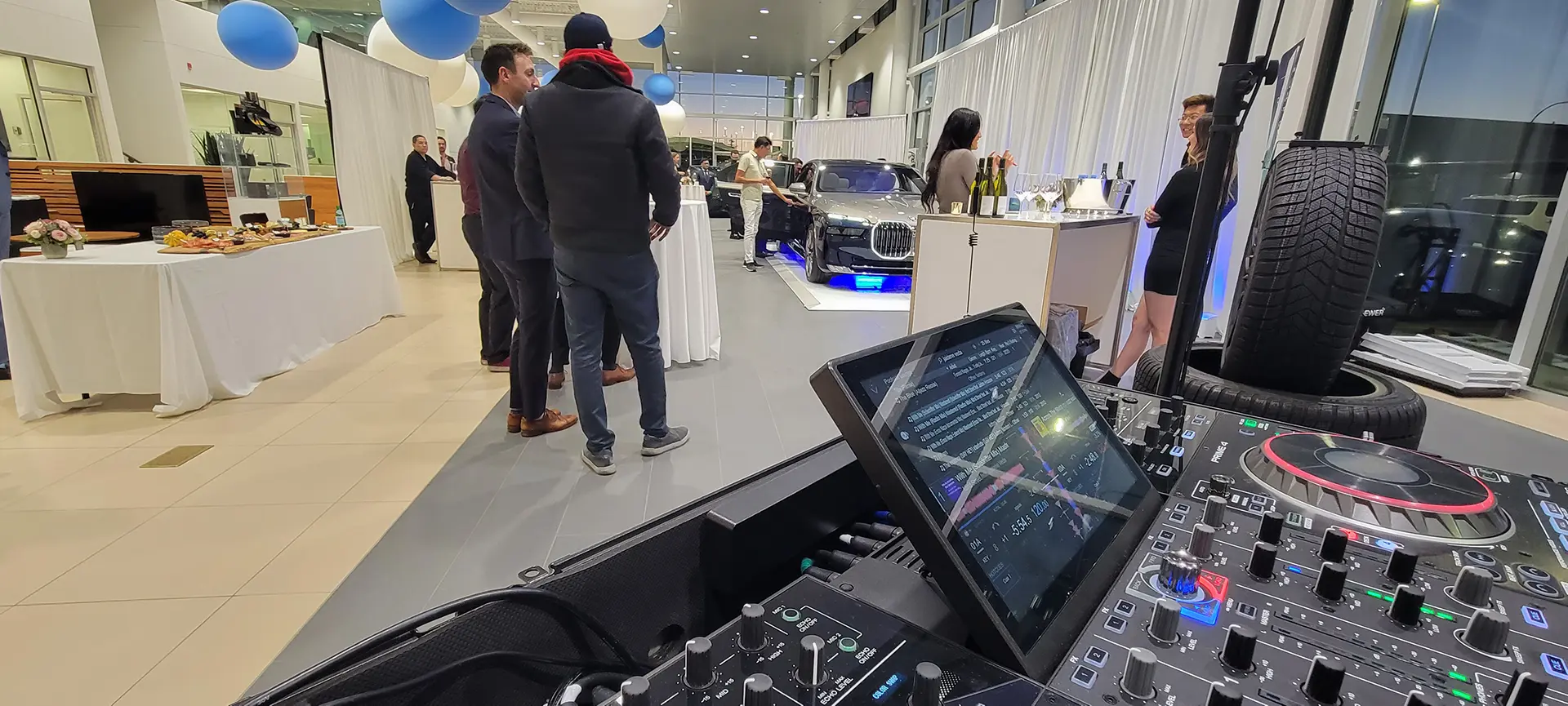
If a DJ is part of the event, it’s worth considering how the presentation audio and entertainment systems will work together.
Having one team coordinate those elements can simplify the technical planning and reduce unnecessary duplication.
7. What Does Corporate AV Rental in Calgary Actually Cost?
This is where things become a little more useful.
AV pricing can vary significantly depending on the equipment required, the size of the venue, the complexity of the setup, and whether technical support is included.
A basic presentation setup is naturally going to cost less than a complete production package for a conference or gala.
At Dance Shout Productions, we offer several starting points for corporate AV rental in Calgary, designed around different event requirements.
Larger events, multi-room setups, galas, awards shows, and productions involving staging, custom lighting, or more complex video requirements are better approached with a custom quote.
The objective is to recommend the right setup for the event, rather than automatically steering everyone toward the most expensive option.
Get in touch for more information or a custom quote today.
8. A Few Questions to Ask Before Booking AV Equipment
Before committing to an AV rental, it’s worth having a conversation about the practical details.
Here are a few questions I’d want answered:
What exactly is included in the rental?
Ask for an equipment list. Understand which speakers, microphones, mixers, screens, projectors, and accessories are included, along with any additional charges.
Is delivery, setup, and teardown included?
Equipment arriving at the venue isn’t the same as equipment being installed, connected, tested, and ready to use.
Confirm who is responsible for each part of the process.
Is an on-site technician included?
Don’t assume that a technician is automatically part of an AV rental. Find out whether someone will be present during the event, what their responsibilities include, and whether additional technical support can be arranged.
Has the venue been considered?
Room dimensions, ceiling height, acoustics, lighting conditions, power access, and existing equipment all influence the appropriate setup.
A quote prepared without understanding the venue may not accurately reflect what your event requires.
Can the equipment accommodate the event schedule?
If you have several presenters, videos, panel discussions, or awards, make sure the provider understands the program and has accounted for the transitions.
A little planning beforehand can save a considerable amount of confusion later.
Getting the Right AV Setup for Your Calgary Corporate Event
The best AV setup isn’t necessarily the biggest, most elaborate, or most expensive.
It’s the one that does exactly what your event needs it to do.
Sometimes that’s a microphone and a compact sound system. Sometimes it’s a full production setup with multiple microphones, projection, lighting, and a dedicated technician managing everything behind the scenes.
The important thing is understanding the difference and making decisions based on the actual requirements of your event.
At Dance Shout Productions, our Calgary AV rental and production services are designed to accommodate everything from straightforward business presentations to larger corporate functions, conferences, galas, and awards nights.
We can help identify what you need, what you don’t, and where additional technical support will make a meaningful difference.
Our approach is fairly straightforward: good equipment, proper preparation, and experienced people who understand how events actually work.
Because the last thing you should be worrying about while welcoming guests, introducing speakers, or presenting awards is whether someone remembered to turn on the microphone.
Planning a corporate event in Calgary? Explore Dance Shout’s AV services or get in touch to discuss a setup that makes sense for your event, your venue, and your budget.